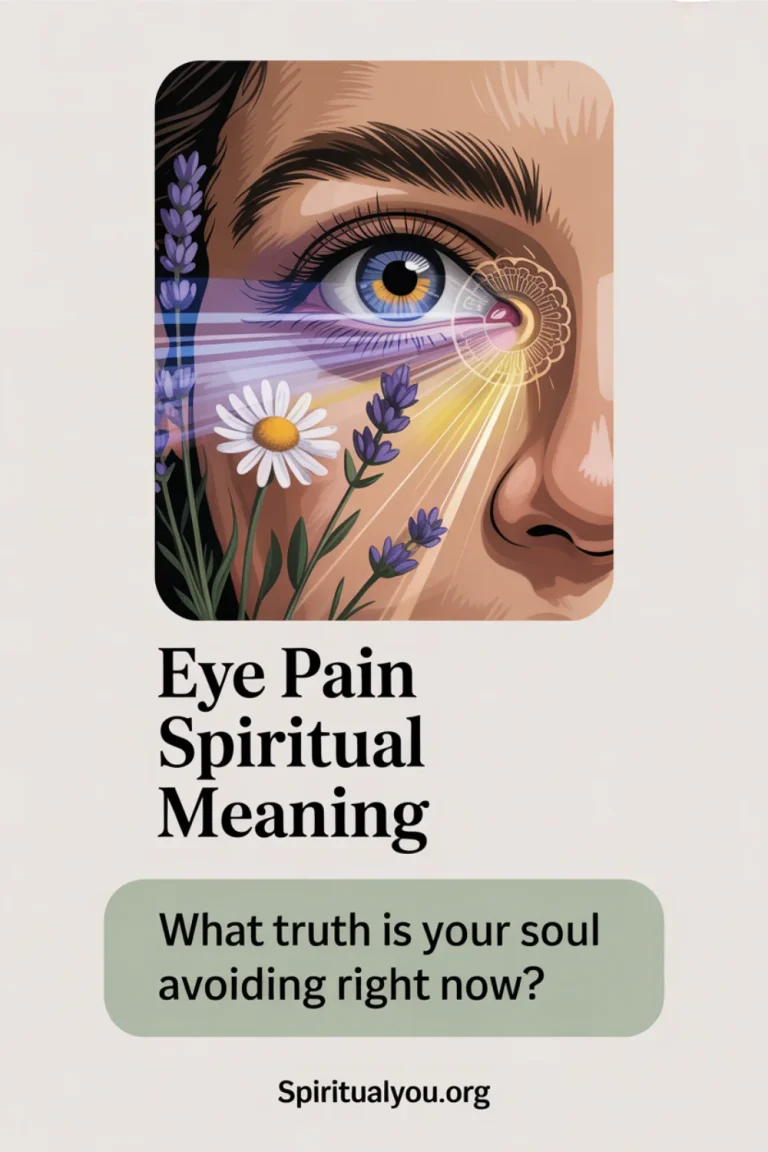
A stye is painful, annoying, and usually shows up at the worst possible time. But what if it’s also trying to tell you something?
Across cultures and spiritual traditions, the eyes are far more than organs of sight. They’re windows to the soul, centers of perception, and powerful symbols of awareness and truth. So when something goes wrong with an eye, many people look beyond the physical cause for a deeper explanation. The spiritual meaning of a stye has been interpreted through superstition, energy work, religious belief, and intuitive wisdom for generations.
In this article, we’ll explore what a stye means spiritually, how the left and right eyes are interpreted differently, what various traditions and superstitions say, and what the message might mean for your life right now.
Table of Contents
- What Is a Stye? A Quick Overview
- Why the Eyes Matter Spiritually
- General Spiritual Meaning of a Stye
- Left Eye Stye Spiritual Meaning
- Right Eye Stye Spiritual Meaning
- Stye on the Eyelid: Does the Position Matter?
- Eye Stye Superstition: A Cross-Cultural Look
- What Does Getting a Stye Mean Spiritually for You?
- What to Do When You Get a Stye Spiritually
What Is a Stye? A Quick Overview
Before diving into the spiritual side, it helps to know what we’re dealing with.
A stye, medically known as a hordeolum, is a small, painful lump that forms on the eyelid. It’s usually caused by a bacterial infection in a hair follicle or oil gland. Symptoms include redness, swelling, tenderness, and sometimes a visible pus-filled bump.
Most styes clear up on their own within a week or two. But their timing, location, and recurrence are what often lead people to ask: what does a stye mean spiritually?
Why the Eyes Matter Spiritually
To understand the spiritual meaning of an eye stye, you first need to appreciate how deeply significant eyes are in spiritual thought.
In almost every major spiritual and religious tradition, the eyes represent:
- Perception and awareness
- Truth and clarity
- The soul and inner life
- Psychic or intuitive ability
- Divine vision and discernment
The “third eye,” located between the brows, is central to many Eastern spiritual practices as the seat of intuition and higher perception. Even in everyday language, we talk about “seeing the truth,” “turning a blind eye,” or “opening our eyes” to something. The connection between sight and understanding runs deep.
When a stye appears, many spiritual thinkers interpret it as a disruption in how you’re seeing, or choosing not to see, something in your life.
General Spiritual Meaning of a Stye
Across traditions, a few core themes emerge when it comes to the spiritual meaning of getting a stye.
You Are Avoiding Something You Need to See
The most widely held spiritual interpretation of a stye is that you’re refusing to look at something clearly. This could be a difficult truth about a relationship, a situation at work, or something within yourself that you’ve been pushing aside.
The eye, as the organ of sight and perception, becomes literally blocked and inflamed. Many people see this as the body mirroring the soul’s resistance to clarity.
Ask yourself: what have I been avoiding looking at honestly?
Negative Energy or the Evil Eye
In many cultures, particularly across the Middle East, Mediterranean, South Asia, and Latin America, styes are directly linked to the evil eye. The evil eye refers to a curse or negative energy sent, intentionally or unintentionally, by someone’s envious or malicious gaze.
In these traditions, a stye is believed to be a physical manifestation of that negative energy landing on you. The remedy often involves protective rituals, amulets like the nazar, or prayers of cleansing.
This is one of the oldest and most widespread stye superstitions in the world.
Unprocessed Emotions Around What You’ve Witnessed
A stye can also signal that you’ve seen something that disturbed or upset you and haven’t fully processed it. Perhaps you witnessed a conflict, discovered an uncomfortable truth, or observed something that contradicted your values. The emotional residue of what you’ve seen can, according to some spiritual frameworks, manifest as physical symptoms in the eyes.
A Call to Cleanse Your Vision
On a broader level, a stye can be interpreted as a prompt to cleanse your perception. This might mean:
- Letting go of judgments or biases that cloud how you see people
- Releasing jealousy or resentment that distorts your view of a situation
- Choosing to see yourself more clearly and honestly
- Opening up to a new perspective you’ve been resisting
Left Eye Stye Spiritual Meaning
In spiritual traditions, the left side of the body is generally associated with the feminine, the receptive, the intuitive, and the inner world. It’s the side that receives energy and impressions from the outside.
A stye in the left eye, therefore, tends to be interpreted through this lens.
Spiritual Meaning of a Stye in the Left Eye
A left eye stye is often seen as a signal related to your inner life and emotional world. Common interpretations include:
- You are receiving too much negative energy from your environment
- Your intuition is trying to get your attention about something or someone
- You are not honoring your emotional truth
- Something in your personal or home life needs closer examination
Some traditions also associate the left eye with the past. A left eye stye may point to unresolved issues from your history that are still affecting how you perceive the present.
Stye in Left Eye Meaning: Superstition
Superstitions around a stye in the left eye vary by culture, but a few themes repeat:
- In some African and Caribbean traditions, a left eye stye signals that someone close to you is being dishonest
- In parts of Asia, it’s seen as a sign of incoming bad luck or a warning to be cautious
- In European folk traditions, a stye in the left eye can indicate that you are being talked about negatively by someone in your circle
Stye in Left Eye Meaning: Superstition for Females
Some cultural traditions assign additional gender-specific meaning. For women, a stye in the left eye has traditionally been interpreted as:
- A sign that a romantic partner or close companion is being unfaithful or secretive
- A warning to trust your instincts in a relationship
- A nudge to pay more attention to your emotional needs
These interpretations are rooted in folk tradition rather than universal spiritual law, so take them as one lens among many.
Stye in Left Eye Spiritual Meaning: Christianity
In Christian spiritual thought, the eyes carry significant symbolic weight. The Bible speaks of the eye as “the lamp of the body” in Matthew 6:22, suggesting that how we see the world reflects the state of our soul.
From a Christian perspective, a stye in the left eye might be interpreted as:
- A call to examine whether you’re seeing people and situations through a lens of grace or judgment
- A reminder to seek God’s perspective rather than relying solely on your own
- A prompt for spiritual self-examination and honest prayer
Some Christian traditions also view physical ailments as invitations to prayer and surrender, rather than punishments. A stye in this context becomes an opportunity to seek healing and clarity, both physically and spiritually.
Right Eye Stye Spiritual Meaning
The right side of the body is traditionally associated with the masculine, the active, the outward-facing, and the conscious mind. It’s the side of action, expression, and engagement with the external world.
A stye in the right eye, therefore, tends to carry a different flavor of meaning.
Spiritual Meaning of a Stye in the Right Eye
A right eye stye is often linked to what you’re projecting outward, how you’re showing up in the world, and how others perceive you. Common interpretations include:
- You are not seeing a situation in your external life clearly
- You are projecting your own fears or judgments onto others
- Someone around you is not who they appear to be
- A decision or path ahead of you requires much more scrutiny before you commit
Some traditions also associate the right eye with the future. A right eye stye may be prompting you to look more carefully at where you’re headed.
Stye in Right Eye Superstition
Right eye stye superstitions tend to focus on external relationships and outcomes:
- In some traditions, a right eye stye means someone is watching you with envy or jealousy
- In others, it’s seen as a sign of incoming good news or a positive change on the horizon
- Some folk traditions interpret it as a warning that someone in your outer circle is untrustworthy
Stye in Right Eye Meaning: Superstition for Females
For women specifically, some cultural traditions interpret a right eye stye as:
- A sign that a new or existing relationship deserves more careful attention
- A warning that someone admiring you may not have good intentions
- A prompt to stand more firmly in your personal power and discernment
Again, these are cultural and folk interpretations. They’re most useful as prompts for reflection rather than predictions.
Stye on the Eyelid: Does the Position Matter?
Some people look even more specifically at where on the eyelid the stye appears.
- Upper eyelid: Often linked to things you are consciously aware of but choosing to overlook. The upper lid frames what’s directly in your field of vision.
- Lower eyelid: May relate to subconscious beliefs or emotions that support, or undermine, how you see the world. The lower lid is less visible, just like the things it’s said to represent.
This level of specificity is more niche and varies widely by tradition. Use it as food for thought rather than a fixed system.
Eye Stye Superstition: A Cross-Cultural Look
The belief that a stye carries meaning beyond the physical is ancient and global. Here’s a brief tour of how different cultures have interpreted it:
- Middle Eastern and Mediterranean cultures: Strongly link styes to the evil eye. Protection through blue glass amulets, prayers, and smoke rituals is common.
- Indian traditions: A stye may be seen as the result of looking at something impure or as a sign of energetic imbalance in the body.
- African folk traditions: Often interpret styes as signals from ancestors or warnings about deception in the immediate community.
- European folk belief: Styes have historically been associated with lying, jealousy, or being the subject of gossip.
- Latin American curanderismo: Views styes as signs of mal de ojo (evil eye) and addresses them through cleansing rituals called limpias.
The specifics differ, but the core idea is strikingly consistent: a stye is not just a physical inconvenience. It’s a signal.
What Does Getting a Stye Mean Spiritually for You?
The most meaningful interpretation is always the one that resonates with your own life. Here are some questions to help you find it:
- Which eye is affected? Left or right, inner world or outer world?
- What have you been refusing to look at honestly?
- Has someone’s jealousy or negative attention been directed at you recently?
- Are you seeing yourself, a relationship, or a situation through a distorted lens?
- What truth is trying to surface that you’ve been keeping in the dark?
Sit with these questions. You don’t need to force an answer. Often, the first thing that comes to mind is the most accurate.
What to Do When You Get a Stye Spiritually
If you believe your stye carries a spiritual message, here’s how to work with it alongside your physical treatment.
Acknowledge the Message
Simply naming it out loud can shift something. Say: “I’m open to seeing what I need to see.” Resistance to a message often prolongs its delivery.
Cleanse Your Energy
If you suspect negative energy or the evil eye is involved, consider an energy cleansing practice that aligns with your beliefs. This could be:
- Smudging your space with sage or frankincense
- Prayer or protective affirmations
- Wearing a protective symbol or amulet
- A salt bath or cleansing ritual
Examine What You’ve Been Avoiding
Set aside quiet time to honestly reflect on what your eye might be asking you to see. Journaling is especially useful here. Write freely without censoring yourself.
Protect Your Energy Going Forward
If you’re prone to picking up others’ negative energy, strengthen your energetic boundaries. This might look like limiting time with draining people, visualizing a protective light around you before entering difficult environments, or grounding yourself daily.
Treat It Physically Too
Warm compresses several times a day are the standard first-line treatment for a stye. Keep the area clean, avoid squeezing it, and see a doctor if it doesn’t improve within a week or two. Spiritual and physical care work best together.
A stye might seem like a minor nuisance, but it has a long history of carrying deeper meaning. Whether you’re drawn to the superstition, the symbolism, or the spiritual message, the invitation is the same: look more closely. At your life, your relationships, and yourself. The answers you need are usually already in plain sight.